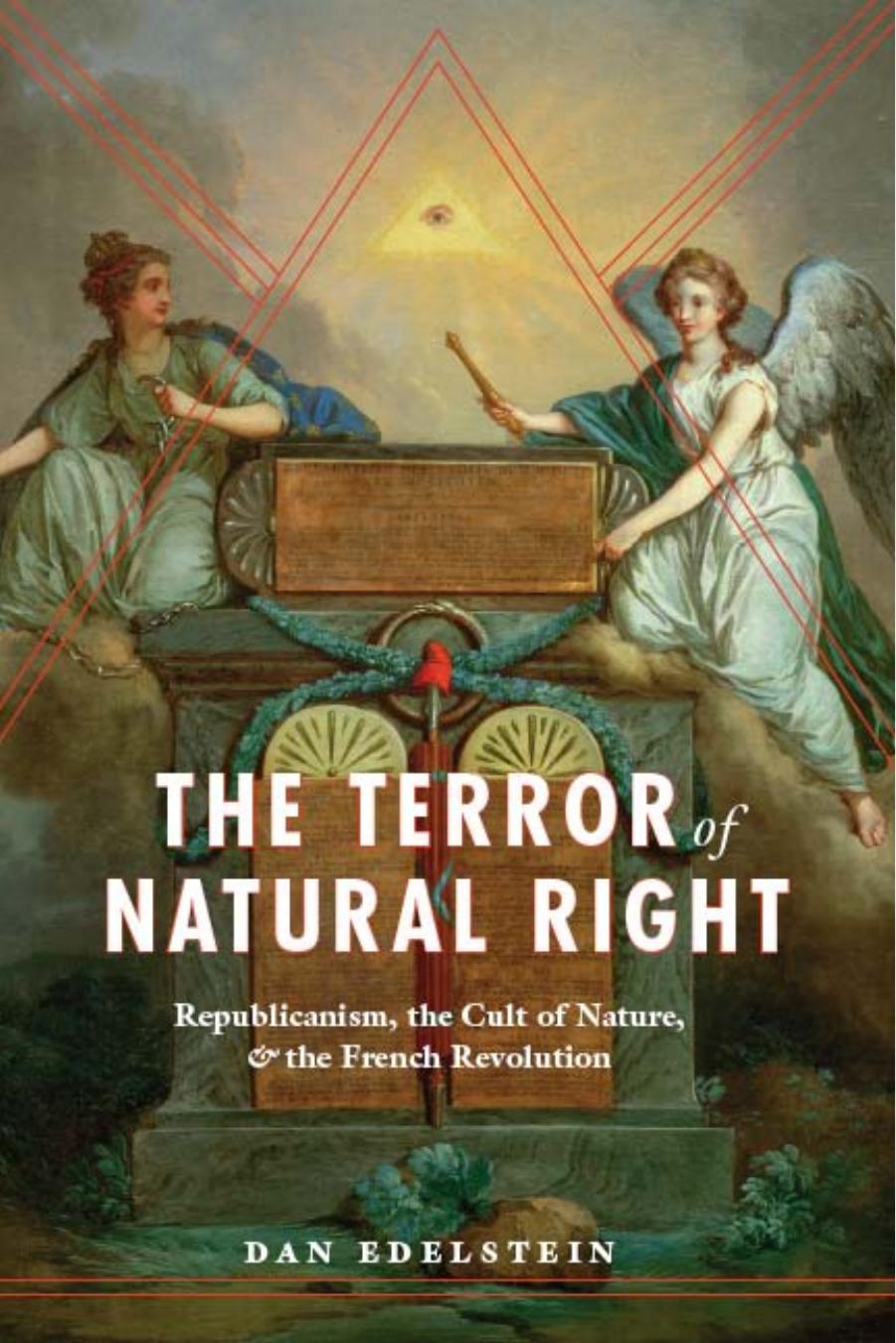
The Terror of Natural Right: Republicanism, the Cult of Nature, and the French Revolution by Dan Edelstein
Author:Dan Edelstein [Dan Edelstein]
Language: eng
Format: epub, pdf
ISBN: 9780226184401
Publisher: Chicago Press
CHAPTER FOUR
THE CASE OF THE
MISSING CONSTITUTION
Of Power and Policy
ON APRIL 10, 1793, Robespierre demanded that Brissot, Vergniaud, Gensonné, Gaudet, and “all of Dumouriez’s other accomplices” be called before the revolutionary tribunal. It had not taken long for the conventionnels to seek to exploit their new institutions for political gain.1 The Convention balked, but two days later, the Girondins had Marat dragged before the tribunal’s bar, only to see him gloriously acquitted on April 24. Was it with this purpose in mind that the Jacobins (and even some Girondin deputies, such as Maximin Isnard) had approved the creation of the tribunal criminel extraordinaire?2 In this context of political recrimination and power struggles, one might wonder whether it is even relevant to recall the natural right foundation of the laws and institutions of the Terror. What could possibly be left of the “Laws of Nature and Nature’s God” in a revolutionary tribunal that by June 1794 seemed to mete out death arbitrarily?
More than the facilitating role of natural right in the history of the Terror, these questions highlight the vaster historiographical problem of ascribing any political or ideological agenda whatsoever to revolutionary leaders after September 1792. If the National Convention was merely the scene of a pitched battle between Montagnards and Girondins, and if the Committee of Public Safety was mostly preoccupied with eliminating rival political groups, does this not suggest that power had become an end in itself, and the only end that mattered? There has certainly been a tendency in recent scholarship to discount any “ideological” explanations for the Terror. According to Patrice Gueniffey, for instance, Robespierre’s republicanism was merely “a rhetorical artifice, not political,” and the Incorruptible had no intention of ever establishing a republic, virtuous or other.3 John Hardman’s biography of Robespierre drives this point home, dwelling on details of cronyism, opportunism, and extortion, at the expense of any political agenda.4 More nuanced, Jean-Clément Martin has brushed a broad portrait of violence during the Revolution, in which “calculation and manipulation” are called on to play starring roles.5
There is no reason to challenge many of the insightful conclusions in these and similar works, but their marked opposition to “revisionist” historiography (Martin, for instance, scoffs at any influence of a “dubious Rousseauism”6) may have blinded them to a more fundamental question: Why should clear instances of political opportunism preclude the copresence of sincere political beliefs? That the vicious political struggles of 1793–94 did in fact pit groups of like-minded actors against other groups certainly suggests that ideological differences mattered. Evidence of certain opportunistic hacks does not imply that everyone was playing a cynical game. Indeed, a dedicated political commitment tends, if anything, to encourage manipulative procedures; one does not need to peer far back in time to find examples of determined ideologues willing to use any means to stay in power, but also to implement radical agendas. To ask historians to choose between cynical and theoretical concepts of power is a question mal posée: The power of ideas can inflame ideas of power.
Download
The Terror of Natural Right: Republicanism, the Cult of Nature, and the French Revolution by Dan Edelstein.pdf
This site does not store any files on its server. We only index and link to content provided by other sites. Please contact the content providers to delete copyright contents if any and email us, we'll remove relevant links or contents immediately.
| Anthropology | Archaeology |
| Philosophy | Politics & Government |
| Social Sciences | Sociology |
| Women's Studies |
The Secret History by Donna Tartt(19010)
The Social Justice Warrior Handbook by Lisa De Pasquale(12179)
Thirteen Reasons Why by Jay Asher(8878)
This Is How You Lose Her by Junot Diaz(6866)
Weapons of Math Destruction by Cathy O'Neil(6253)
Zero to One by Peter Thiel(5776)
Beartown by Fredrik Backman(5722)
The Myth of the Strong Leader by Archie Brown(5487)
The Fire Next Time by James Baldwin(5418)
How Democracies Die by Steven Levitsky & Daniel Ziblatt(5207)
Promise Me, Dad by Joe Biden(5135)
Stone's Rules by Roger Stone(5070)
A Higher Loyalty: Truth, Lies, and Leadership by James Comey(4942)
100 Deadly Skills by Clint Emerson(4904)
Rise and Kill First by Ronen Bergman(4766)
Secrecy World by Jake Bernstein(4733)
The David Icke Guide to the Global Conspiracy (and how to end it) by David Icke(4691)
The Farm by Tom Rob Smith(4494)
The Doomsday Machine by Daniel Ellsberg(4477)
